
INTRODUCTION :
The tomb of King Tutenkhamen had been discovered by British archaeologist and Egyptologist Howard Carter along with his sponsor Lord Carnarvon on 4th of November,1922 in the valley of kings(KV62). It was untouched for more than 3000 years.Findings from Tutenkhamen’s tomb has been shaken the world with breathtaking facts about Egyptians.This is considered as one of the most significant archaeological discoveries in modern era.
At last have made wonderful discovery in valley; a magnificent tomb with seals intact; re-covered same for your arrival; congratulations.—Telegram from Howard Carter to Lord Carnarvon on 5th November,1922.
TUTANKHAMUN :FAMILY AND KINGDOM
- Tutenkhamun was one of the last kings of Egypt’s 18th dynasty. He was born around 1342 B.C. in the Egyptian city of Akhetaton (today’s Tell el-Amarna).Genetic research has verified that he was son of Akhenaten (also known as Amenhotep IV) and his mother is believed to be one of Akhenaten’s sisters. Around 1336/1333 B.C at the age of 9 or 10 he became pharaoh. In the early years of his reign , Tutenkhamun and his court were moved to Memphis(the administrative capital near modern Cairo) from Tell el-Amarna.
- During his reign Tutenkhamun helped to restore traditional Egyptian religion and art, both of which had been set aside by his predecessor Akhenaten. He issued a decree restoring the temples, images, personnel, and privileges of the old gods. He began the protracted process of restoring the scared shrines of Amon, which had been severely damaged.
- Research shows that around the age of 12, he married his half-sister Ankhesenpaaton(later known as Ankhesenamun), Akhenaten’s third daughter by his wife Nefertiti.The couple had no surviving children, although mummified fetuses of two stillborn daughters were found in Tutenkhamun’s tomb. He died shortly after an accident around 1326/1323 B.C.,in the ninth or tenth year of his reign.
TUTANKHAMUN: MEANING
The king is famous by the name ‘Tutenkhamun’ in today’s world but this was not the story from the very beginning. At birth, he was in fact named ‘Toutankhaton’ , meaning ‘living image of Aton’ .
After some years once he ascended the throne he changed his name to ‘Tutankhamun ’, meaning ‘living image of Amon’.
This new name ‘Tutankhamun’ is the proof of his desire to distinguish himself from the reign of Akhenaten and also affirms his allegiance to the Theban God Amon.
This new name ‘Tutankhamun’ is the proof of his desire to distinguish himself from the reign of Akhenaten and also affirms his allegiance to the Theban God Amon.
CAUSE OF DEATH :
It’s been 98 years of the unveiling of Tutenkhamun’s tomb and still today death of Tutenkhamun is a centre of controversy. Different theories have been suggested based on various aspects of his mummy but no one knows what exactly caused his death.- Tutenkhamun died between the ages of 17 and 19. An x-ray taken in1968 revealed damage to his skull which could have been caused by a fall, a blow to the head, or during mummification.
- Dr. Hawass’s investigations in 2005 led to a new reason of the king’s death. The CT scans revealed that the king had suffered a fracture to the left femur. More importantly there was an amount of embalming fluid into that break which suggests the wound was still open at the time of death, and also there were no signs that it had started to heal. According to Dr. Hawass’s team that wound might had caused an infection which finally finished Tutenkhamun off.
- Another theory on Tutenkhamun’s death suggests that he was murdered by General Horemheb , a man of low birth who became one of Akhenaten’s closest advisors. Under Tutenkhamun, he was appointed commander-in-chief of the army and deputy of the king. Following the demise of Tutenkhamun and Ay, Horemheb became pharaoh. During his reign , he had the names of Akhenaten, which suggests that he had personal reasons for eradicating those rulers from the record.
- Tutenkhamun’s tomb was prepared in a hurry. Microbes has been found on the wall of the tomb which indicates that the paint of the wall wasn’t dry when the tomb was sealed.
- Some researchers suggest that Tutenkhamun died of a chariot accident as many parts of his body were missing. But it can be said that the body parts had been damaged during the time of unboxing his mummy from the sarcophagus.
TUTANKHAMUN'S TOMB :
- After death Tutenkhamun’s body was mummified as per the Egyptian religious tradition which says royal body should be preserved for afterlife. His body was wrapped in resin-soaked bandages, a 24 pound solid gold portrait mask was placed over his head and shoulders and he was laid in a series of nested containers—three golden coffins, a granite sarcophagus and four gilded wooden shrines.
- Inside the antechamber of the tomb, it was an whole another world. Egyptians believe that there should be everything of a person’s necessity with his mummy as he is going to live his afterlife.
- Tutenkhamun tomb was packed with umpteen valuable goods. To quote Carter “.......strange animals, statues and gold —everywhere the glint of gold. For the moment—an eternity it must have seemed to others standing by—I was struck dumb with amazement....”
- The antechamber of the tomb was stuffed nearly to the ceiling with more than 5000 artifacts including furnitures, chariots, clothes, weapons, walking sticks and so much more—most of them gold—in “organized chaos.”
- Two life-size statues of the king was there facing each other as if to protect the sealed entrance which was between them. Inside the coffin of Tutenkhamun 150 items—most of them are made of gold—including amulets, bracelets, collars, rings and daggers have been found.
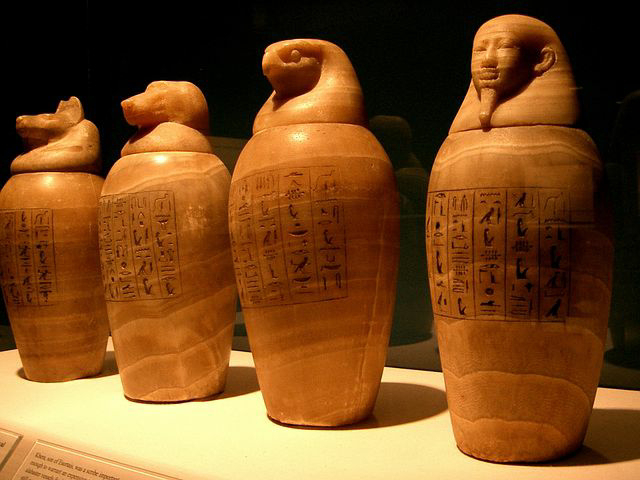
- A large gilded canopic shrine had been found inside which there was a canopic chest made out of a single block of calcite. The chest was full of four canopic jars, nicely decorated and shaped as Egyptian coffin, holding pharaoh’s embalmed organs : liver, lungs, stomach, and intestines.

FOUR CANOPIC JARS TO PRESERVE ORGANS
CURSE OF TUTANKHAMUN :
Unveiling of Tutenkhamen's tomb has anchored a well-liked story of 'curse of the pharaoh ', also known as 'Tutenkhamun's curse' according to which people who were connected to the discovery of that tomb will be lead to death by Tutenkhamen's curse as they have dared to violate the king's final resting place.
Late Egyptologist Dominic Montserrat's comprehensive search says that the concept began with a strange "striptease" in 19th century London. In a live stage show in which real Egyptian mummies were unwrapped, inspired the writers to pen tales of mummy revenge.
Investigator James Randi concludes that people who were involved in this discovery had an average duration of life of more than twenty-three years after the curse was supposed to become effective. Carter who not only discovered it but also physically opened it and removed the mummy of Tutenkhamen from there sarcophagus, lived until 1939, sixteen years after the event.
According to Randi when Tutenkhamen's tomb was discovered and opened it was a great archeological revelation. In order to keep the press at bay and yet allow them a sensational aspect Carter himself put out this story of Tutenkhamen's curse to keep intruders away from this history-making discovery.

KING TUTANKHAMUN
CONCLUSION :
Unearthing of king Tutenkhamun's tomb has inaugurated a new chapter of Egyptian civilization as well as human civilization. Artifacts from King Tutenkhamun’s tomb have been toured the world in several famous museum shows, including the worldwide 1972-79 “Treasures of Tutankhamun” exhibitions. The minor boy-king has become one of the most celebrated characters of history after 3000 years of his death who would have made remarkable contributions to Egypt’s history if not for his early death.
Thank you for visiting.
Please leave your opinion in the comment section.❤
RESOURCES :
- National Geography
- thought.com
- history extra.com
- historytoday.com
- livescience.com
- britannica.com
- Researchgate




3 Comments
Keep it going.. cheers 👍
ReplyDeleteThank you.
Deletevery informative information
ReplyDelete